

Perhaps you plan your month around your period. You keep painkillers in your bag, cancel arrangements at the last minute, or push through a working day while wishing you could curl up somewhere quiet.
When this happens regularly, it can gradually become your version of normal. Especially if you have been told that painful periods are simply part of being a woman.
But pain that repeatedly interrupts your life deserves attention. Endometriosis is one possible explanation — and understanding your symptoms is a worthwhile first step.
You do not have to wait until the pain becomes unbearable to ask for help.
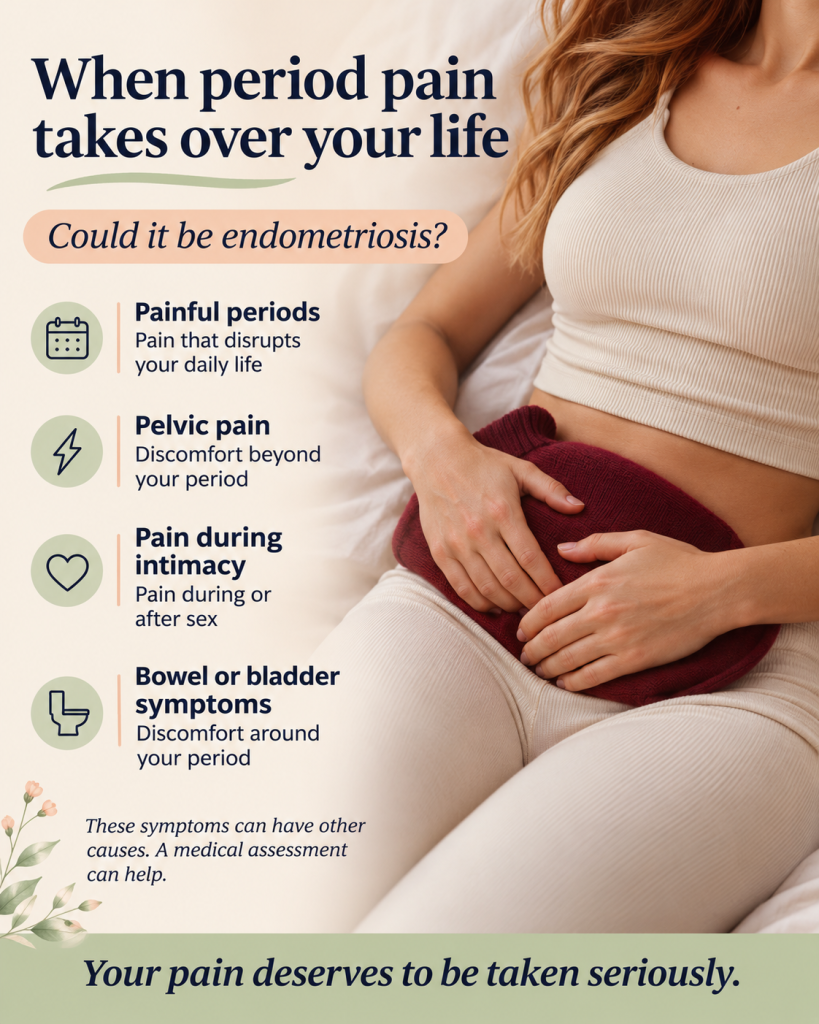
When is period pain worth investigating?
Some discomfort during a period is common. However, pain that stops you working, studying, sleeping or enjoying everyday activities is a reason to speak to a healthcare professional.
It is also worth seeking advice if your symptoms are getting worse, your usual pain relief is not helping, or pain occurs at other times of the month.
You do not need to prove that your pain is worse than somebody else’s. What matters is how it affects you.
Could it be endometriosis?
Endometriosis is a condition in which tissue similar to the lining of the womb grows elsewhere, commonly within the pelvis. It can cause inflammation and pain, although experiences vary considerably.
Symptoms may include:
- Period pain that disrupts everyday activities.
- Pain in the lower abdomen, pelvis or lower back.
- Pain during or after sex.
- Pain when opening your bowels or passing urine, particularly around your period.
- Heavy periods or significant tiredness.
- Difficulty becoming pregnant.
Having these symptoms does not automatically mean you have endometriosis. Other conditions, including adenomyosis, fibroids, ovarian cysts and bowel problems, can cause overlapping symptoms. An assessment helps explore the possibilities.
“My scan was normal — why am I still in pain?”
A normal ultrasound can be reassuring about some conditions, but it does not rule out endometriosis.
Ultrasound can identify certain findings, including endometriosis-related ovarian cysts, and may detect deep endometriosis when performed by someone with appropriate expertise. Other forms can be difficult to see.
If symptoms persist, your doctor should consider them alongside the examination and scan findings. Further assessment, specialist imaging or a discussion about laparoscopy may be appropriate. You should not assume that continuing pain has no explanation simply because an earlier scan appeared normal.
What happens during an assessment?
The starting point is a conversation about your experience: where the pain occurs, when it happens, how long it lasts and what it prevents you from doing.
Your doctor may also ask about bleeding, bowel and bladder symptoms, discomfort during sex, previous treatment and any plans for pregnancy. An examination or pelvic ultrasound may be offered where appropriate, with your consent.
A short symptom diary can help. Note the dates of your periods, when pain occurs, any associated symptoms and whether medication helps. Bring previous scan reports and a list of medicines if you have them.
You do not need a perfectly organised account. It is fine to begin with: “My periods are affecting my life, and I would like to understand why.”
What treatment might help?
There is no single approach that suits everyone. Options can include pain relief, hormonal treatment and, for some women, surgery following specialist assessment.
The right discussion depends on your symptoms, medical history, previous treatment and whether you are trying to become pregnant. Treatment may sometimes begin while investigations continue.
There is currently no cure for endometriosis, but treatment can help manage symptoms. If an approach is not helping, a review is worthwhile.
Support for pelvic pain in Watford
At Phoenix Women’s Health, you can see a consultant gynaecologist to discuss painful periods, persistent pelvic pain or an existing endometriosis diagnosis.
Your appointment can include a pelvic ultrasound where clinically appropriate, an explanation of the findings and a discussion of treatment or further investigations. If specialist imaging or hospital-based care is needed, your consultant will explain the next steps.
You deserve the opportunity to talk openly about your symptoms and understand your options.
Find out more or arrange an appointment
Explore endometriosis and pelvic pain care in Watford
View clinic dates and contact Phoenix Women’s Health
When to seek urgent help
Pelvic pain that is severe or worsening, or accompanied by faintness, shoulder-tip pain, difficulty breathing or heavy vaginal bleeding, needs emergency assessment: call 999 or go to A&E. If you have pelvic pain and may be pregnant, or have fever or vomiting, seek urgent advice through NHS 111.